Artificial Intelligence (AI) has changed the way students learn, study, and complete assignments. Instead of spending hours searching for information or trying to understand difficult topics alone, students can now use AI study tools to learn faster and more effectively. These tools can explain complex subjects in simple words, create study notes, solve math problems, summarize long articles, improve writing, and even help prepare for exams.
Whether you are a high school student, a college student, or someone learning new skills online, AI study tools can save time and make learning more enjoyable. However, the best results come from using AI as a learning assistant—not as a replacement for your own thinking. AI can help you understand concepts, but real learning still happens when you practice, ask questions, and apply what you have learned.
In this guide, you will discover some of the best AI study tools available today, their features, benefits, and how they can improve your learning experience. You will also find tips for choosing the right tool and using AI responsibly.
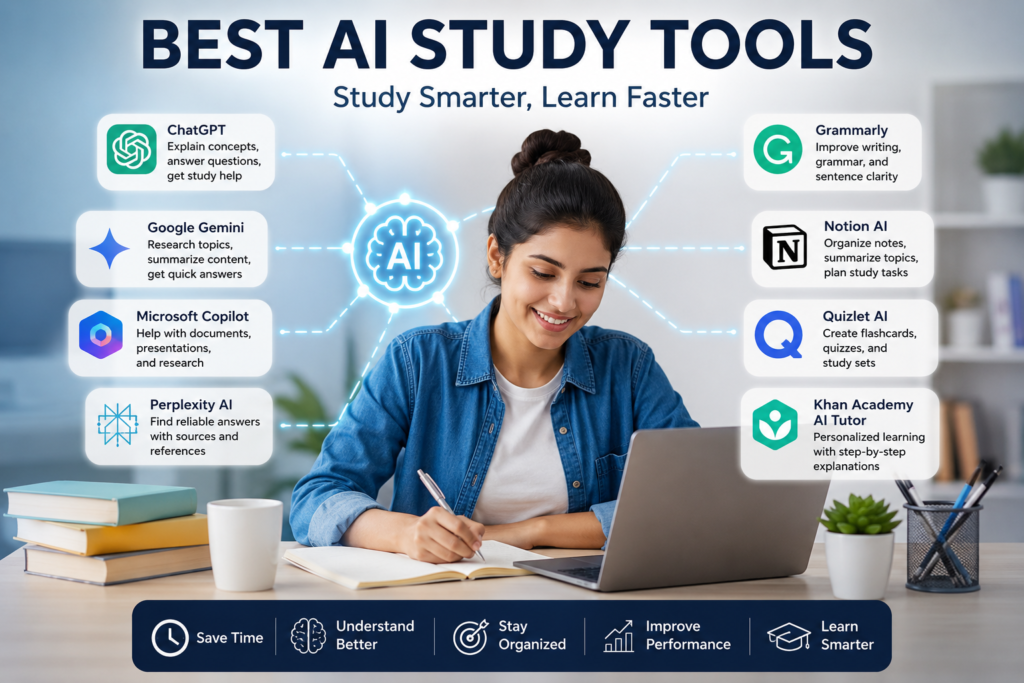
Why AI Study Tools Are Becoming Popular
Students today face many challenges. They have to complete assignments, prepare for exams, attend classes, manage projects, and balance personal responsibilities. AI study tools help reduce this workload by making studying faster and more organized.
One of the biggest reasons these tools are popular is that they provide instant help. Instead of waiting for a teacher or tutor, students can ask questions at any time and receive explanations within seconds. Many AI tools also adjust their responses according to the student’s learning level, making difficult subjects easier to understand.
Another advantage is personalization. Every student learns differently. Some understand better through examples, while others prefer summaries, quizzes, or visual explanations. AI tools can provide different learning methods based on individual needs, making studying more effective.
As AI technology continues to improve, these tools are becoming more accurate, interactive, and useful for students of all ages.
Benefits of Using AI Study Tools
AI study tools offer many benefits that go beyond simply answering questions.
They save valuable time by summarizing textbooks, research papers, and lengthy notes into shorter, easier-to-read content. This allows students to focus on understanding key ideas rather than spending hours reading every page.
These tools also improve learning by breaking down difficult topics into simple explanations. Subjects such as mathematics, science, economics, and computer programming become easier to understand when explained step by step.
Many AI tools provide writing assistance by checking grammar, improving sentence structure, and suggesting clearer wording. This helps students create better essays, reports, and research papers.
Another major benefit is better organization. AI tools can create study schedules, flashcards, quizzes, and revision plans that help students prepare more effectively for exams.
Quick Comparison of Popular AI Study Tools
| AI Tool | Best For | Main Features | Free Version |
|---|---|---|---|
| ChatGPT | General learning | Explanations, writing, brainstorming, coding help | Yes |
| Google Gemini | Research and learning | Information search, summaries, study help | Yes |
| Microsoft Copilot | Productivity | Document assistance, research, writing | Yes |
| Perplexity AI | Research | Answers with sources, summaries | Yes |
| Grammarly | Writing improvement | Grammar, spelling, tone suggestions | Yes |
| Notion AI | Note-taking | Summaries, organization, writing | Yes |
| Quizlet AI | Exam preparation | Flashcards, quizzes, study sets | Yes |
| Khan Academy AI Tutor | Personalized learning | Guided explanations and practice | Limited |
ChatGPT – Your Personal AI Study Assistant
ChatGPT is one of the most useful AI tools for students. It can answer questions, explain difficult concepts, help with homework, generate study notes, solve coding problems, and improve writing.
Students can ask questions in simple language and receive easy-to-understand explanations. If the first explanation is confusing, they can ask for another example or request an even simpler explanation.
ChatGPT also helps students prepare for interviews, create practice quizzes, summarize chapters, and organize study plans. It supports many subjects including mathematics, science, history, business, programming, literature, and languages.
To get the best results, students should ask clear and specific questions. For example, instead of asking “Explain biology,” asking “Explain photosynthesis for a high school student with examples” usually leads to a much more helpful answer.
Google Gemini for Research and Learning
Google Gemini is another helpful AI study tool that makes finding information easier. It is especially useful for research because it can summarize information, explain concepts, compare topics, and assist with brainstorming ideas.
Students can use Gemini to understand current events, prepare presentations, and organize project ideas. It also works well for generating outlines before writing essays or reports.
Gemini is particularly useful when students need quick explanations while studying multiple subjects at once. It helps simplify complex information into easy-to-read content.
Microsoft Copilot for Productivity
Microsoft Copilot works well for students who regularly use Word, Excel, PowerPoint, and other Microsoft applications.
It can help create presentations, summarize documents, organize research, improve writing, and analyze information quickly.
Students working on large assignments often save significant time by using Copilot to organize ideas and generate first drafts that they can later edit and personalize.
Perplexity AI for Reliable Research
Perplexity AI is becoming increasingly popular among students because it provides answers along with references to supporting sources. This makes it easier to verify information and continue deeper research.
Instead of simply giving an answer, Perplexity often points users toward articles and websites where they can learn more about the topic.
This feature is especially useful for research papers, college assignments, and academic projects where accurate information is important.
Grammarly for Better Writing
Good writing is an important skill for every student. Grammarly helps improve essays, assignments, emails, and reports by checking grammar, spelling, punctuation, and sentence clarity.
It also suggests improvements that make writing more professional and easier to read.
Students can learn from Grammarly’s suggestions over time, helping them become stronger writers instead of simply correcting mistakes.
Notion AI for Smart Note-Taking
Organizing study materials can be difficult, especially during exam season. Notion AI helps students keep notes, assignments, and study plans in one place.
It can summarize meeting notes, organize information into lists, generate outlines, and help students manage their daily tasks.
Many students use Notion AI as a digital notebook that keeps everything organized and easy to find.
Quizlet AI for Exam Preparation
Quizlet has long been popular for flashcards, and its AI features make studying even more effective.
Students can create flashcards automatically from notes, generate quizzes, and practice with different learning modes.
Repeated practice helps improve memory and increases confidence before exams.
Quizlet is particularly useful for learning vocabulary, definitions, formulas, historical dates, and scientific terms.
Khan Academy AI Tutor
Khan Academy’s AI-powered tutor is designed to help students understand concepts rather than simply providing answers.
It guides students through problem-solving step by step, encouraging them to think independently.
This approach helps students build stronger learning habits and develop deeper understanding instead of memorizing information.
How to Choose the Right AI Study Tool
Not every AI tool is suitable for every student. Choosing the right one depends on your learning goals.
If you need help understanding concepts, choose a conversational AI assistant.
If your main focus is improving writing, a grammar and writing assistant may be the better option.
Students preparing for exams may benefit more from flashcard and quiz-based tools, while researchers may prefer tools that include reliable sources and references.
Trying a few free versions before purchasing a subscription is often the best approach.
Tips for Using AI Study Tools Effectively
AI works best when combined with active learning.
Instead of copying answers directly, try asking AI to explain topics step by step. Practice solving problems yourself before checking the AI-generated solution.
Use AI to create quizzes, summarize notes, and prepare revision plans. Always verify important facts using textbooks, trusted educational websites, or your teacher’s guidance.
Remember that AI can occasionally make mistakes, so critical thinking remains an essential part of learning.
Common Mistakes Students Should Avoid
Some students depend too much on AI and stop practicing independently. This can reduce long-term understanding.
Another mistake is copying AI-generated assignments without reviewing them. Every assignment should be checked carefully to ensure it is accurate, original, and follows your teacher’s instructions.
Students should also avoid entering sensitive personal information into AI tools and always follow their school’s academic integrity policies.
Comparison Table: Which AI Tool Should You Choose?
| If You Need… | Recommended Tool |
|---|---|
| Homework Help | ChatGPT |
| Research | Perplexity AI |
| Essay Writing | Grammarly |
| Note Organization | Notion AI |
| Presentation Help | Microsoft Copilot |
| Exam Revision | Quizlet AI |
| Personalized Learning | Khan Academy AI Tutor |
| General Study Support | ChatGPT or Google Gemini |
Best Practices for Studying with AI
A balanced study routine delivers the best results. Start by reviewing your class notes, then use AI to clarify any confusing topics. Ask follow-up questions until you fully understand the concept instead of memorizing an answer.
Create short summaries after each study session, use AI to generate practice questions, and test yourself regularly. Revising topics over several days is much more effective than studying everything in one long session.
Finally, combine AI tools with traditional learning methods such as reading textbooks, attending classes, participating in discussions, and solving practice exercises. This combination builds stronger knowledge and improves long-term memory.
Conclusion
AI study tools have made learning easier, faster, and more personalized than ever before. From explaining difficult concepts and improving writing to creating flashcards and organizing study schedules, these tools can help students become more confident and productive learners.
However, AI should be viewed as a study partner rather than a shortcut. The most successful students use AI to understand concepts, practice regularly, and strengthen their own skills instead of relying on it to complete all of their work.
By choosing the right AI study tool and using it responsibly, students can improve their academic performance, save valuable study time, and develop stronger learning habits that will benefit them throughout their education and future careers.